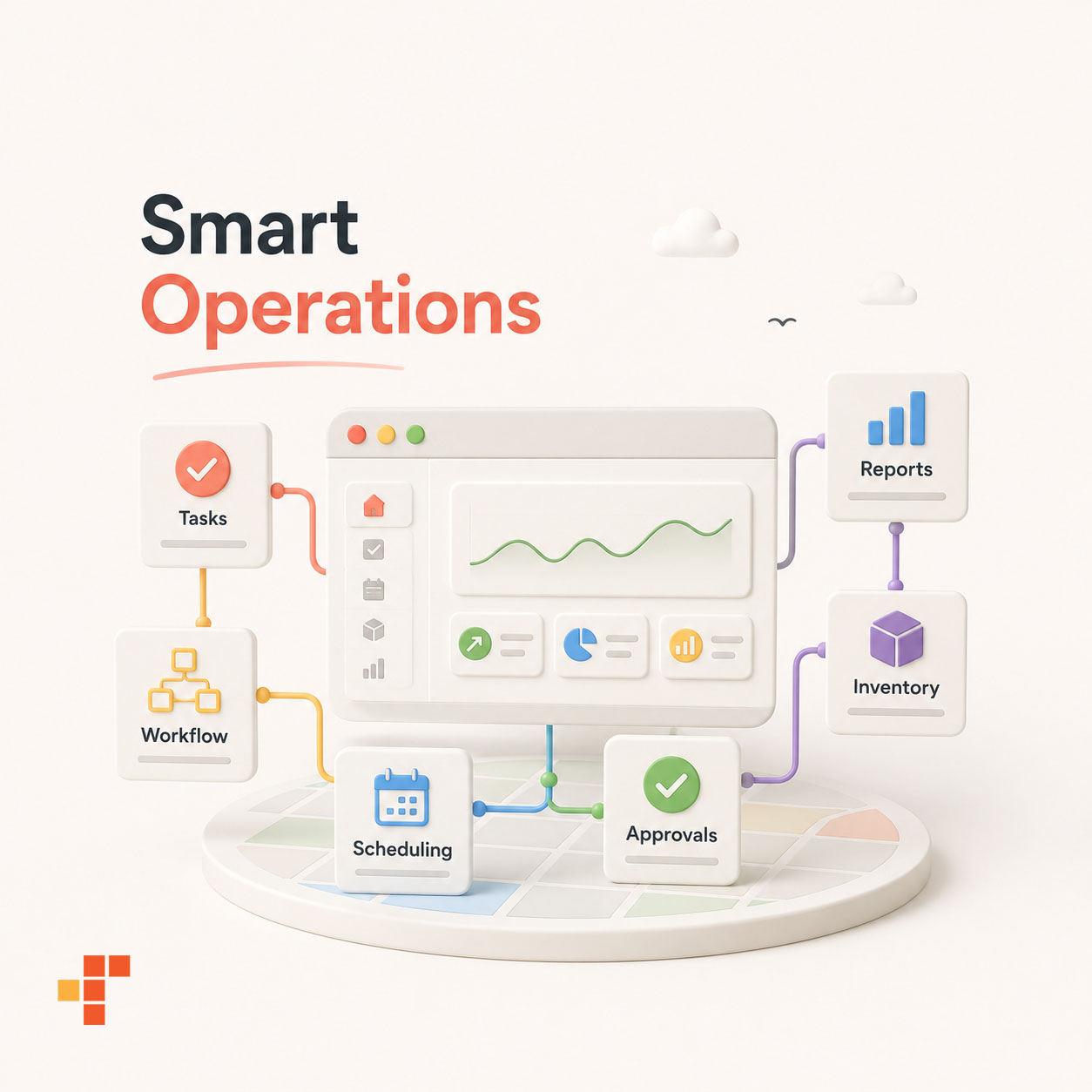
Operations software is a digital system that helps a business manage its daily work in one organized place. It can support tasks, approvals, customers, employees, assets, reports, inventory, projects, service requests, documents, and performance tracking. The goal is simple. It helps the business reduce manual work, avoid confusion, and make better decisions with clearer information.
Many businesses grow faster than their internal systems. At the beginning, a notebook, Excel file, WhatsApp group, and phone calls may be enough. Later, the same methods become stressful. Information gets scattered. Managers keep asking for updates. Employees repeat the same work. Reports take too long. Customers wait longer than they should. This is usually the moment when operations software becomes important.
Why operations become difficult without software
When a business depends too much on manual work, small problems repeat every day. A task may be forgotten because it was only mentioned in a call. A customer request may be missed because it was sent in a chat group. A manager may not know the real status of a project because the latest update is in someone else’s file. Finance, HR, sales, and operations may all have different versions of the truth.
These problems are not always caused by lazy workers or poor management. Many times, the real issue is that the business does not have a central system. People are working hard, but the work is not organized. Operations software gives structure to the daily workflow so everyone can see what needs to be done, who is responsible, what is pending, and what has already been completed.
What operations software can manage
Operations software can be built for different types of businesses. A school may use it to manage students, parents, teachers, payments, attendance, and reports. A hospital or clinic may use it to manage patients, appointments, staff, departments, and records. A service business may use it to manage leads, customers, tasks, invoices, follow ups, and support requests. An NGO may use it to manage projects, field reports, documents, approvals, assets, HR workflows, and dashboards.
This is why operations software should not be treated as one fixed product for every company. A good system should match how the business actually works. Some companies need a simple task and reporting system. Others need a full platform with user roles, approvals, dashboards, CRM features, document management, and automated notifications.
Pixelwel builds custom operations software around real business workflows. Instead of forcing your team to adjust to a rigid system, we study how your work happens and create a digital platform that makes the process smoother.
Operations software compared with ERP and CRM
People often ask whether operations software is the same as ERP or CRM. They are related, but they are not always the same. A CRM system mainly helps you manage customers, leads, communication, follow ups, and sales opportunities. An ERP system usually connects wider business areas such as finance, inventory, procurement, HR, and operations. Operations software can sit between these ideas or combine parts of both depending on the business need.
For example, a company may not need a full ERP immediately, but it may need a practical operations system to manage tasks, approvals, reports, and customers. Another company may start with operations software and later expand it into a larger ERP style platform. The best choice depends on the size of the business, the problems it is facing, and the level of control it needs.
How operations software saves time
One of the biggest benefits of operations software is time saving. When requests, tasks, approvals, files, and reports are managed in one system, people spend less time searching, calling, repeating, and correcting mistakes. A manager can open a dashboard and see progress instead of asking every department one by one. An employee can see assigned tasks and deadlines clearly. A customer request can be tracked until it is solved.
Automation also plays a major role. The system can send reminders, generate reports, notify the right person, record approvals, and organize data automatically. This helps the team focus on productive work instead of repeating the same administrative steps every day.
If your business is already losing time through repeated manual tasks, you may also find our article on how automation saves Ethiopian businesses time every day useful.
Why custom operations software can be better than ready made tools
Ready made software can be useful for simple needs, but it often becomes limiting when your business has specific workflows. Many Ethiopian businesses have unique approval processes, local payment methods, reporting formats, user roles, language needs, and internal structures. A ready made tool may cover part of the problem, but then the team still uses Excel, WhatsApp, paper, and email to fill the gaps.
Custom operations software solves this by building the system around your real process. It can include the exact roles your team needs, the exact reports your manager wants, the exact forms your staff use, and the exact workflow your organization follows. This makes adoption easier because the system reflects how the business actually works.
At Pixelwel, we build systems for practical use. We focus on clean dashboards, simple navigation, role based access, useful reports, and workflows that reduce confusion. The goal is not to make the system complicated. The goal is to make daily work easier.
Signs your business needs operations software
Your business may need operations software if managers constantly ask for updates manually, if reports take too long to prepare, if files are scattered, if approvals are difficult to track, if employees are unsure who is responsible for what, or if customers are waiting because internal follow up is weak. These signs usually mean the business has outgrown its current way of working.
The right software does not replace good management. It supports good management. It gives leaders better visibility, gives employees clearer responsibilities, and gives customers a smoother experience.
How Pixelwel can help
Pixelwel helps businesses design and build custom operations software, CRM systems, dashboards, school management systems, hospital management systems, internal portals, and workflow automation platforms. We combine UI and UX design, web development, database structure, and business process thinking to create systems that are useful in real work.
If your business also needs a professional public website, you can read our guide on choosing a website development company in Ethiopia. A strong website brings customers in, while strong operations software helps you serve them better after they arrive.
Final thought
Operations software is not only for large companies. Any growing business that wants better organization, faster work, clearer reporting, and stronger control can benefit from it. The important thing is to build the right system for the real problem.
Pixelwel creates operations software that helps businesses reduce manual work, improve visibility, and manage daily operations with confidence. If your team is working hard but still feeling disorganized, the solution may not be more pressure. It may be a better system.