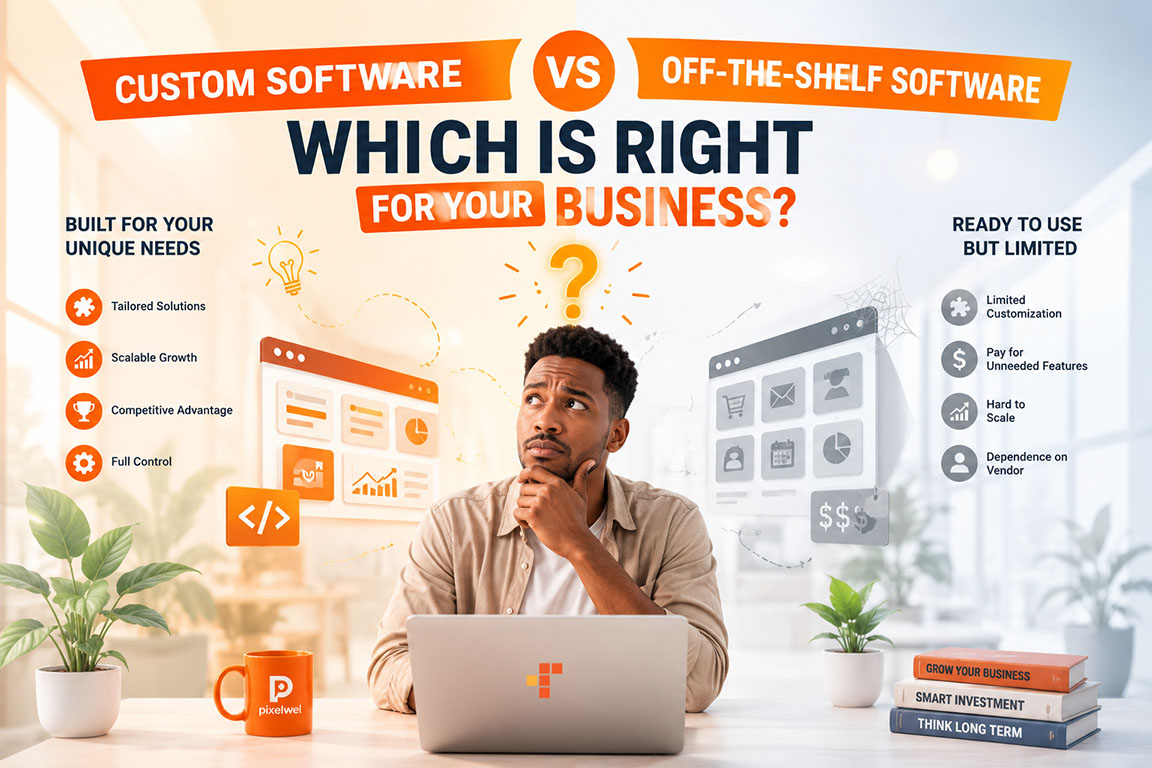
Every growing business eventually faces an important technology decision: should you purchase ready-made software or invest in a custom solution built specifically for your organization?
The answer depends on your business goals, workflows, budget, and future growth plans. While off-the-shelf software can solve common problems quickly, custom software offers flexibility, scalability, and competitive advantages that generic solutions often cannot provide.
This guide explains the strengths and weaknesses of both approaches so you can make an informed decision.
What Is Off-the-Shelf Software?
Off-the-shelf software is designed for a large audience. Examples include accounting systems, project management tools, CRM platforms, and inventory software that thousands of businesses use.
These products are developed to solve common business problems rather than the unique needs of one company.
Advantages
- Quick deployment.
- Lower initial investment.
- Regular updates.
- Large user communities.
- Training resources.
- Vendor support.
Disadvantages
- Limited customization.
- Features you never use.
- Monthly or annual subscription fees.
- Dependence on the software vendor.
- Difficult integration with unique workflows.
What Is Custom Software?
Custom software is designed specifically for your organization. Every feature, workflow, report, and dashboard is built around how your business actually operates.
Instead of changing your business to fit software, the software is built to fit your business.
Advantages of Custom Software
1. Designed Around Your Workflow
Your employees continue working the way they already understand while the software improves efficiency behind the scenes.
2. Better Productivity
Employees only see the tools they need instead of navigating through unnecessary menus and features.
3. Scalability
As your business grows, additional modules can be added without replacing the entire system.
4. Competitive Advantage
Custom software supports processes that competitors cannot easily copy because the solution is built specifically for your business.
5. Easier Integration
Custom systems can integrate with payment gateways, accounting software, ERP platforms, SMS providers, email systems, mobile apps, and third-party APIs.
Challenges of Custom Software
- Higher initial investment.
- Development takes time.
- Requires ongoing maintenance.
- Choosing the right development partner is essential.
Cost Comparison
Factor Off-the-Shelf Custom Software Initial Cost Low Higher Monthly Fees Usually Required Optional Customization Limited Unlimited Scalability Depends on Vendor Built Around Your Growth Ownership Vendor Owns Platform You Own the SolutionWhen Should You Choose Off-the-Shelf Software?
Ready-made software is a good choice if:
- Your business is just starting.
- Your requirements are standard.
- You need a solution immediately.
- Your budget is limited.
- You do not require specialized workflows.
When Should You Invest in Custom Software?
Custom software becomes the better investment when:
- Your business has unique processes.
- You manage large amounts of operational data.
- Your employees perform repetitive manual work.
- You need advanced reporting.
- You want to automate workflows.
- You require integration with multiple systems.
- You expect significant business growth.
Real Business Example
Imagine a logistics company managing deliveries through spreadsheets, WhatsApp messages, and paper records.
A custom system could automatically:
- Assign drivers.
- Track deliveries.
- Generate invoices.
- Notify customers.
- Create management dashboards.
- Monitor vehicle performance.
Instead of managing several disconnected tools, the company operates from one centralized platform.
Long-Term Return on Investment
Although custom software requires a larger initial investment, it often reduces long-term operational costs by improving efficiency, reducing manual work, minimizing errors, and eliminating recurring subscription fees.
For growing businesses, these savings frequently outweigh the development cost within a few years.
Choosing the Right Technology Partner
Technology alone does not guarantee success. The development partner should understand your business, analyze your workflows, recommend practical solutions, and provide ongoing support after deployment.
Look for experience, communication, technical expertise, security practices, and a strong portfolio before selecting a software development company.
Conclusion
There is no universal answer. Off-the-shelf software is ideal for many standard business needs, while custom software delivers greater flexibility and long-term value for organizations with unique requirements.
The best choice depends on where your business is today—and where you want it to be in the future.
How Pixelwel Can Help
At Pixelwel, we help businesses identify the right technology solution for their goals. Whether you need a modern website, CRM system, business dashboard, workflow automation platform, document management system, or fully customized software, we build solutions that improve efficiency and support sustainable growth.
Our approach focuses on understanding your business first, then developing technology that simplifies operations, enhances productivity, and creates measurable business value.